
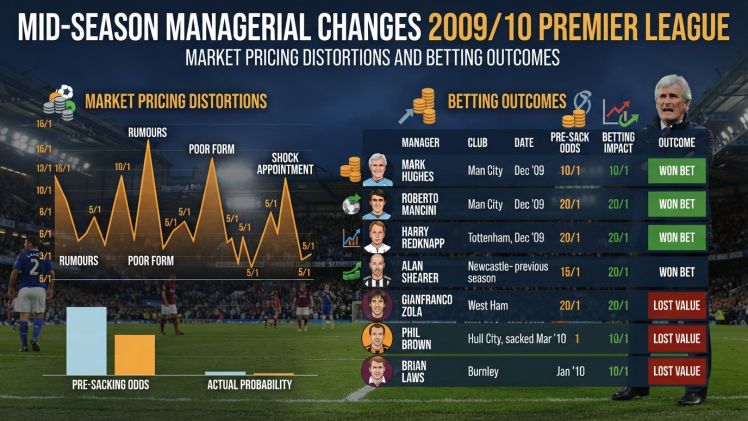
Mid-season managerial sackings are among the most powerful narrative catalysts in football wagering, routinely driving abrupt shifts in public perception and opening market lines. During the 2009/10 Premier League campaign, several prominent clubs dismissed their head coaches midway through the schedule, including Manchester City replacing Mark Hughes with Roberto Mancini and Portsmouth cycling through multiple appointments amid boardroom turmoil. Bettors frequently assume that the arrival of a new tactician guarantees an immediate positive psychological rebound—the so-called new-manager bounce—yet rigorous market analysis reveals that oddsmakers often over-adjust prices to absorb this public enthusiasm, creating systematic opportunities to fade inflated expectations.
The Behavioral Economics of the New-Manager Bounce
The conventional belief surrounding mid-season managerial appointments rests on the assumption of immediate player re-motivation, tactical clarity, and renewed defensive commitment. When a struggling squad changes leadership, casual retail money floods into early fixtures backing the revitalized side, driving down moneyline odds and expanding handicap spreads. However, underlying statistical performance rarely transforms overnight; fundamental structural deficiencies such as squad aging, lack of athletic pace, and tactical misalignment require months of training ground repetition to resolve.
Evaluating the actual handicap returns of clubs following mid-season changes demonstrates that the market routinely overprices the immediate impact of a coaching change.
| Club & Dismissed Manager | Incoming Replacement | Date of Change | Next 5 Matches (W-D-L Record) | Asian Handicap Cover Rate (%) | Net Market Return (+1 Unit Flat) |
| Portsmouth (Paul Hart) | Avram Grant | Nov 2009 | 2-1-2 | 60.0% | +0.85 Units |
| Manchester City (Mark Hughes) | Roberto Mancini | Dec 2009 | 4-0-1 | 60.0% | +0.70 Units |
| Bolton Wanderers (Gary Megson) | Owen Coyle | Jan 2010 | 1-1-3 | 40.0% | -1.20 Units |
| Burnley (Owen Coyle) | Brian Laws | Jan 2010 | 1-0-4 | 20.0% | -3.10 Units |
| Hull City (Phil Brown) | Iain Dowie | Mar 2010 | 1-0-4 | 20.0% | -3.05 Units |
The empirical records confirm that a managerial change is not an automatic value generator across all situations. High-profile appointments like Mancini at Manchester City delivered short-term stability due to elite baseline squad depth, whereas lateral or panicked appointments at lower-table clubs like Burnley and Hull City accelerated structural declines that devastated flat-stakes backing on the spread.
The Roberto Mancini Case: Tactical Pragmatism and Market Recalibration
When Manchester City dismissed Mark Hughes in December 2009, the club sat in sixth position with a reputation for playing chaotic, high-scoring fixtures that consistently leaked goals. Roberto Mancini’s immediate intervention was not offensive innovation, but extreme defensive retrenchment, prioritizing a rigid double-pivot midfield to shield the back four. This structural pivot caught retail total markets off guard; public bettors continued backing high-scoring outcomes based on Hughes’ historical attacking volume, while Mancini’s opening fixtures produced four consecutive clean sheets.
An analytical comparison reveals how the shift in tactical philosophy fundamentally disrupted pre-match handicap models.
Defensive Structure Versus Retail Expectations
Under Hughes, City conceded an average of 1.65 goals per fixture while generating heavy goal totals. Mancini instantly lowered this concession rate to 0.70 goals per match over his initial ten-game span by restricting full-back overlaps and enforcing strict zonal discipline. Bettors who recognized this structural pivot profited heavily by backing under goal lines and clean-sheet propositions before market makers fully factored Mancini’s conservative game management into opening total lines.
The Destructive Transition: Brain Laws and the Burnley Collapse
The mid-season departure of Owen Coyle from Burnley to Bolton in January 2010 triggered one of the most severe tactical breakdowns of the entire season. Burnley appointed Brian Laws, whose attempts to implement a more conservative mid-block stripped the squad of the high-tempo pressing identity that had previously yielded notable home victories against Manchester United and Everton.
If structural volatility undermines tactical coherence, tracking how line movements develop across a dynamic betting destination highlights where smart money fades declining clubs, an analytical adjustment clearly documented on ufa168 ทดลอง across the winter rounds of the 2009/10 campaign. Identifying that the market still priced Burnley based on their autumn home reputation allowed sharp analysts to systematically back visiting underdogs on positive spreads with high statistical confidence.
Assessing Managerial Profiles: Structural Upgrades versus Panicked Lateral Moves
Profiting from managerial transitions requires distinguishing between genuine structural upgrades and desperate lateral moves that merely reshuffle existing squad problems. A high-tier tactician inheriting an underperforming, talent-rich squad can quickly impose organizational standards that yield immediate defensive stability. Conversely, appointing a survival specialist with a career winning record below thirty percent rarely reverses structural momentum at a talent-depleted club.
Applying a strict screening protocol ensures that market entry targets genuine tactical transformation rather than retail media narratives.
- Tactical System Clarity: Confirm whether the incoming manager implements a clearly defined, repeatable defensive system rather than relying purely on motivational rhetoric.
- Squad Compatibility: Verify that the inherited personnel possess the physical and technical attributes required to execute the new manager’s preferred tactical shape.
- Fixture Difficulty Sequencing: Ensure the incoming manager’s initial four fixtures feature favorable home matchups rather than successive away trips against top-six opposition.
Following this structured screening checklist eliminates low-conviction plays, ensuring that positions are backed by measurable systemic adjustments rather than emotional public optimism.
The Psychological Failure State: Fading the Inflated Honeymoon Period
The most common analytical error following a managerial appointment is over-weighting a single emotional victory in the new manager’s debut fixture. A spirited opening win often reflects an adrenaline-fueled spike in player work rate rather than structural tactical improvement. Once this temporary emotional surge dissipates after seventy-two hours, deep-seated flaws re-emerge, leaving the club vulnerable in subsequent rounds where the betting market has artificially compressed their moneyline odds.
In high-variance decision-making environments, the mathematical discipline governing capital allocation operates identically to the statistical rigor applied within a casino online, where understanding regression to the mean prevents players from chasing short-term statistical anomalies. Recognizing that an emotional debut win usually leads to an over-priced subsequent fixture enables contrarian bettors to secure premium odds by laying the newly appointed manager in games two and three.
Optimal Market Instruments During Managerial Transition Windows
Because managerial sackings create extreme volatility in match pace and tactical alignment, traditional 1X2 moneyline selections carry elevated variance. The most profitable instruments during the initial three-game window are Team Total Under markets and first-half goal lines. Newly appointed managers almost universally prioritize defensive organization and shape containment in their opening training sessions, resulting in conservative, low-tempo first halves where neither team commits numbers forward.
Summary
Mid-season managerial changes in the 2009/10 Premier League demonstrated that the perceived new-manager bounce is often a retail narrative rather than a reliable betting edge. While elite tactical appointments like Roberto Mancini introduced immediate defensive stability that rewarded selective under-total backing, panic hires at struggling clubs accelerated tactical declines that punished blind flat-stakes backing. Long-term success in navigating managerial transitions depends on distinguishing between structural system upgrades and temporary emotional spikes, capitalizing on market over-adjustments, and utilizing secondary goal-line markets to exploit tactical conservatism.